
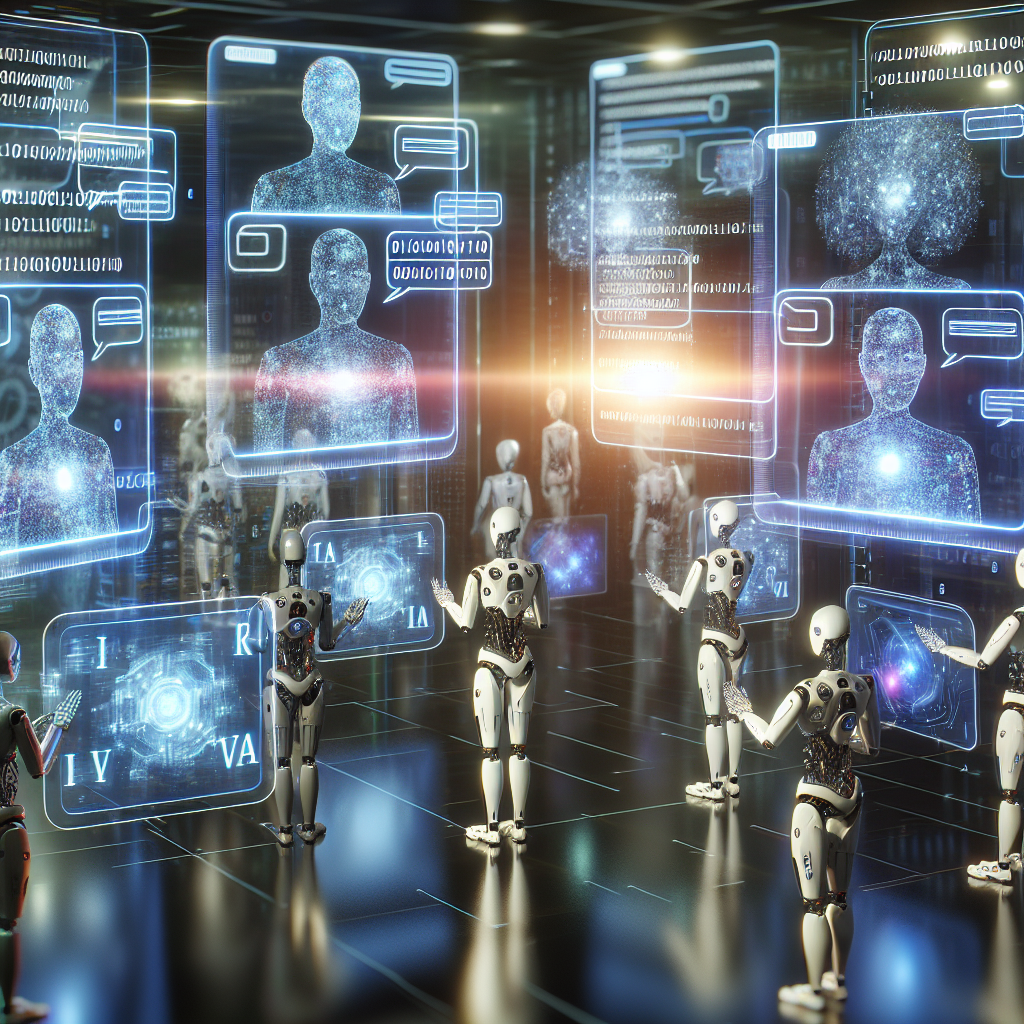
Unleashing the Power of GibberLink: How AI Agents Communicate in Robo-Language
Artificial Intelligence (AI) is not just a futuristic concept anymore; it’s an integral part of our daily lives. GibberLink is at the forefront of AI technology, offering a revolutionary approach by enabling AI agents to communicate using a sophisticated robo-language. But what does this mean for the future of technology, and how does it work? In this article, we’ll dive deep into the intricacies of GibberLink, exploring the how, why, and profound what-ifs of AI-to-AI communication.
What is GibberLink?
GibberLink is a cutting-edge framework that allows AI agents to communicate directly with each other by using a "robo-language" specifically developed for seamless inter-agent conversation. This technology leverages natural language processing (NLP) and advanced machine learning algorithms to create a unique language that various AI systems can understand and use efficiently.
Key Features of GibberLink
- Customizable Protocols: Allows AI systems to tailor communication protocols for specific tasks.
- Scalability: GibberLink can support communication among a vast network of AI agents.
- Efficiency: Increased processing speeds, reducing the time required for complex operations.
How Does AI Communication Work in GibberLink?
Understanding the nuts and bolts of GibberLink requires unraveling some of the technical intricacies that fuel its capabilities. Below are the core components and mechanisms that make AI communication possible under this framework:
The Role of Natural Language Processing
Natural Language Processing (NLP) is at the heart of GibberLink’s functionalities. NLP enables AI systems to comprehend and generate human-like responses, translating them into a standardized robo-language.
- Syntax and Semantics: AI understands the structural and contextual components of language.
- Machine Translation: Converts human language inputs into a universal AI-readable format.
- Sentiment Analysis: Assesses the ‘intent’ behind each communication, ensuring accurate delivery.
Machine Learning Algorithms
The machine learning algorithms employed in GibberLink allow AI agents to learn and adapt their communication styles over time. The key algorithms include:
- Deep Learning Networks: Enable the AI to recognize patterns in data.
- Reinforcement Learning: Use feedback loops to improve communication effectiveness.
- Supervised Learning: AI training through labeled data for specific communication scenarios.
Benefits of AI-to-AI Communication
The potential benefits of AI agents communicating with each other in a dedicated language are vast and significant.
Enhanced Decision-Making
AI-to-AI interaction through GibberLink heralds a new era of decision-making capabilities:
- Faster Data Processing: Accelerated communication leads to quick decision-making.
- Collaborative Problem Solving: AI agents work together seamlessly to solve complex problems.
- Increased Accuracy: Reduced errors common in human communication.
Improved Efficiency and Automation
Through GibberLink, automation can reach new heights, resulting in:
- Optimized Resource Management: AI agents manage resources without human intervention.
- Real-time Analysis: Live monitoring and adaptation to new information.
- Cost Reduction: Decreased need for human resources in communication-intensive tasks.
Challenges and Ethical Considerations
While GibberLink offers a myriad of benefits, it also brings various challenges and ethical considerations that must be acknowledged:
Ensuring Security and Privacy
AI communication protocols must secure data exchange and protect privacy:
- Encryption: Employing robust encryption methods to safeguard transmitted data.
- Access Control: Ensuring only authorized AI agents can access certain data.
Maintaining Human Oversight
The increasing autonomy of AI agents raises questions about control and ethical use:
- Human-in-the-loop Systems: Guaranteeing humans retain the ultimate decision-making power.
- Transparent AI: AI processes must remain understandable to human operators.
Addressing Bias in AI Language
Bias can inadvertently be embedded into AI systems via data:
- Data Diversity: Ensuring training data is diverse and representative.
- Bias Detection: Utilizing algorithms that identify and mitigate bias.
Future Prospects of AI-to-AI Communication
The advent of GibberLink in the AI landscape paints a promising future. Here’s how AI-to-AI communication is poised to revolutionize different sectors:
Transforming Industries
- Healthcare: AI agents can coordinate patient care, content exchanges, and diagnoses.
- Finance: Automated trading systems and fraud detection processes.
- Manufacturing: Optimizing supply chain management and production protocols.
Fostering Innovation
With AI agents communicating efficiently, innovation will take on new dimensions, spurring advancements in various technological domains.
- Smart Cities: Enhanced infrastructure for urban planning and sustainability.
- Advanced Robotics: Coordinated efforts among robotic systems for research and exploration.
Conclusion: Embracing a Connected AI Future
As GibberLink propels the world into the next stage of AI evolution, it’s essential for businesses, developers, and policymakers alike to understand and embrace the possibilities it offers. By enabling a seamless communication framework among AI agents, GibberLink is not just enhancing efficiency and productivity, but it’s also setting the groundwork for a connected future where AI can assist in transforming societal functions on every level. The journey might be fraught with challenges, but the potential rewards point towards a future where technology truly works for the betterment of humankind.
Explore the impact of GibberLink further and join the conversation on AI evolution in the comments below!