
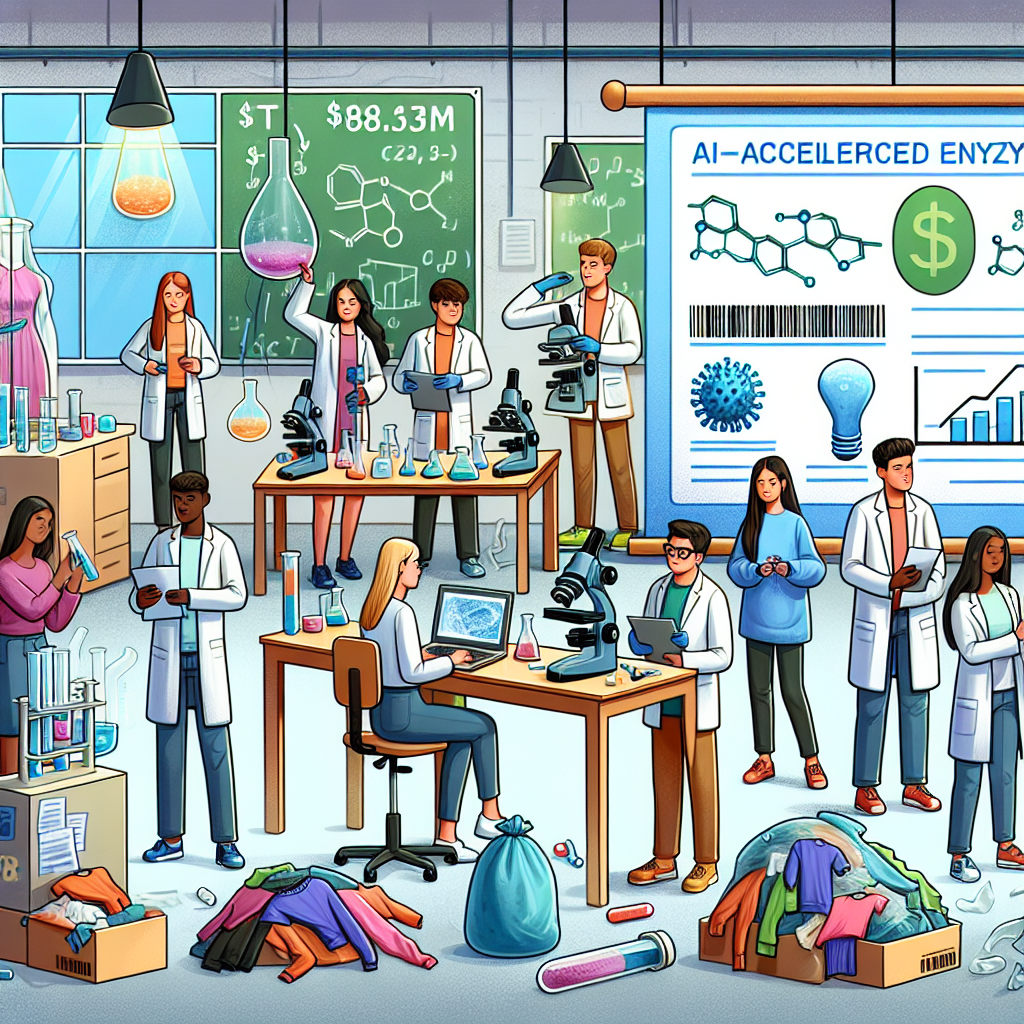
Breathing New Life Into Fast Fashion: How AI-Accelerated Enzymes Are Transforming Plastic Waste
Welcome to a story that seamlessly blends innovation, determination, and sustainability—a tale that began as a simple high school science project and blossomed into a groundbreaking solution for the fast fashion industry’s mounting plastic waste. When you think of fast fashion, you probably envision stylish clothing at affordable prices, but lurking beneath this veneer of fashion-forward trends, there exists a pressing environmental problem: plastic waste. Today, thanks to the tenacity of young innovators, we’re on the verge of a revolution that could change the fashion industry forever with AI-accelerated enzymes.
Unveiling the Problem: Plastic Waste in Fast Fashion
The fast fashion industry is notorious for its rapid production cycles, delivering the latest trends almost weekly. However, this efficiency comes at an environmental cost:
- High Textile Waste: The fashion industry accounts for around 92 million tons of waste each year.
- Environmental Impact: Synthetic fibers like polyester, derived from plastic, are pervasive in clothing manufacturing, contributing to environmental degradation.
- Landfill Overflow: A staggering 85% of textiles are sent to landfills each year.
While consumers enjoy low-cost clothing, the environmental toll mounts, and traditional solutions prove insufficient. Enter the realm of science and technology, where AI-accelerated enzymes take center stage.
From a School Lab to a Multimillion-Dollar Solution
The Birth of an Idea
Our journey begins with a group of high school students who ventured into the world of biotechnology. Fascinated by nature’s ability to decompose organic material with enzymes, they wondered: Could we harness these enzymes to degrade synthetic fibers just as efficiently?
Initial Experiments
- Research: The students delved into enzyme research, focusing on those capable of breaking down polyester at a molecular level.
- Experimentation: Using basic lab equipment, they tested various enzymes, identifying initial candidates with potential.
A Leap to AI
To optimize enzyme effectiveness, they introduced AI algorithms. By simulating countless enzyme behaviors and interactions, the AI pinpointed the most promising enzyme combinations to target synthetic fibers.
Startup Success
- Funding: Impressed by the potential, investors committed a whopping $18.3 million to elevate this project from lab to large-scale application.
- Technology Development: With financial backing, the team developed AI-driven platforms for enzyme production and deployment.
The Science Behind AI-Accelerated Enzymes
What Are Enzymes?
Enzymes act as biological catalysts that speed up chemical reactions within cells:
- Biodegradation: Some enzymes can break down polymers like plastic into smaller, harmless components.
- Reusability: Enzymes can be reused multiple times, making them an efficient solution for ongoing waste degradation.
Role of AI
- Optimization: AI algorithms analyze enzyme activity patterns and identify combinations that yield the highest degradation rates.
- Data Analysis: Massive datasets are processed to fine-tune enzyme efficiency and discover new degradative pathways.
Benefits for the Environment
- Reduced Plastic Waste: Targeted enzyme action drastically cuts down plastic pollutants in the fashion industry.
- Lower Carbon Footprint: The process is energy-efficient compared to traditional recycling methods.
- Sustainable Practices: Encourages circular economy principles by promoting textile recycling and waste reduction.
The Future of Fast Fashion
Industry Adoption
Slowly but surely, fashion brands are adopting these enzyme solutions to mitigate their environmental impact:
- Production Changes: Incorporating sustainable practices in manufacturing lines.
- Consumer Awareness: Brands market their eco-friendly initiatives to environmentally-conscious consumers.
Challenges Ahead
Despite the promising outlook, challenges remain:
- Scalability: Scaling enzyme production to meet industrial demands poses logistical hurdles.
- Cost: Initial investment and adaptation costs for brands can be substantial.
Conclusion: A Step Towards Sustainable Fashion
The story of AI-accelerated enzymes is a testament to human ingenuity and the power of youth to drive global change. From a high school science project to a multimillion-dollar company, this innovation holds the potential to reshape the landscape of fast fashion and bring us closer to a sustainable future.
So, as you admire the latest clothing trends, remember that behind the scenes, dedicated minds are working tirelessly to ensure that fashion doesn’t have to come at the expense of our planet. Embrace this revolution, and together, let’s make sure that fashion is as good for the environment as it is for our wardrobes.