
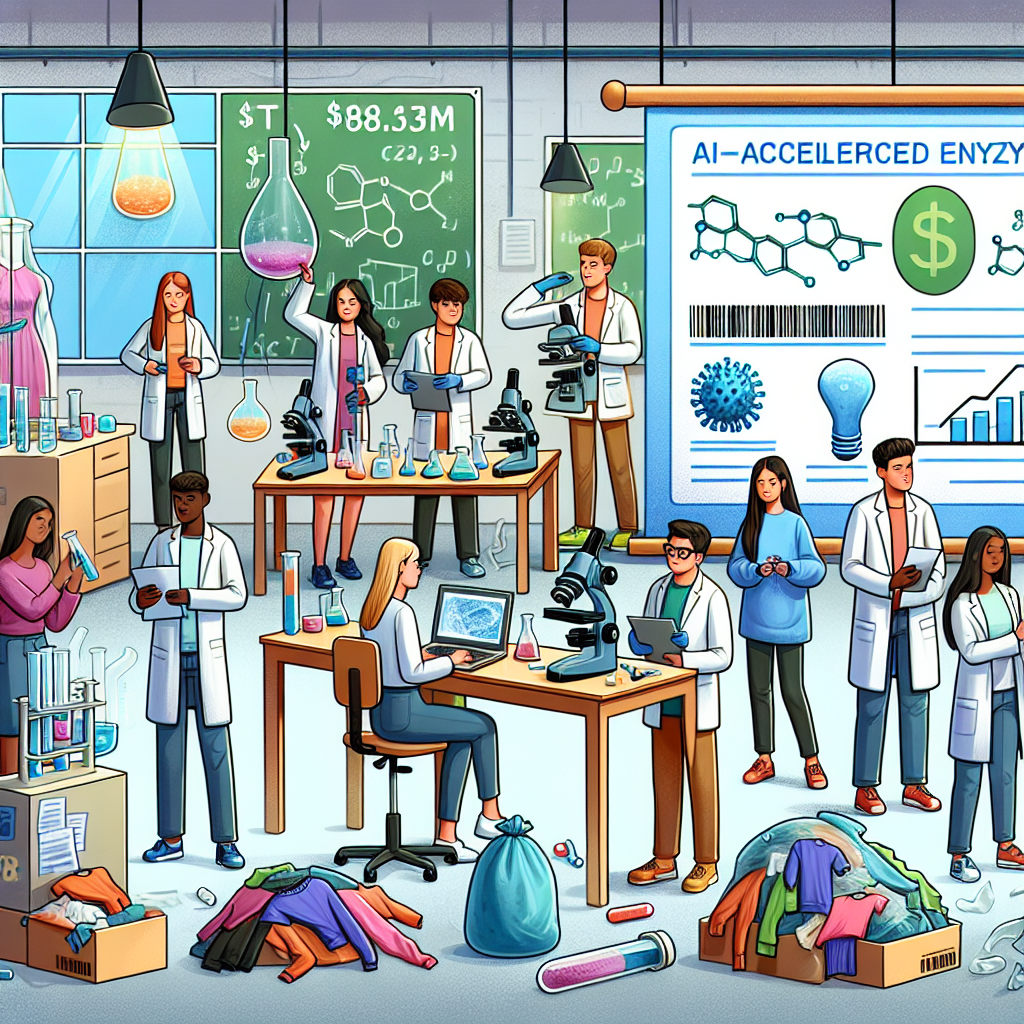
From School Science Project to Millions: AI-Accelerated Enzymes Target Fast Fashion’s Plastic Waste Problem
In a remarkable twist of fate, what started as a high school science project on enzyme research has culminated in an $18.3 million venture aimed at tackling one of the fashion industry’s most pressing challenges: plastic waste. This gripping story unfolds at the intersection of groundbreaking technology and one of the globe’s most wasteful industries—fast fashion.
In this article, we will explore how artificial intelligence is speeding up enzyme research to potentially revolutionize the handling of plastic waste in fashion. We’ll delve into the innovations that brought an initial classroom curiosity into the spotlight and discuss why this technological leap may be exactly what the environment needs.
Understanding Fast Fashion’s Impact on the Environment
Before diving into enzyme technologies, it’s crucial to understand the colossal problem that fast fashion poses.
The Runaway Growth of Fast Fashion
Fast fashion brands have mushroomed globally, largely responsible for making clothing affordable and accessible. Yet, this industry:
- Produces a whopping 92 million tons of waste annually.
- Accounts for around 10% of global carbon emissions.
- Consumes an incredible 79 trillion liters of water, producing textile waste laden with microplastics.
These alarming statistics pose two immediate questions: how do we combat this escalating problem, and how can technology play a role?
The Genesis of AI-Accelerated Enzymes
From Science Fair to Sustainability Hero
This story’s protagonist is a young student who initially became interested in enzyme research within the confines of a high school science project. Enzymes, which act as catalysts in breaking down substances, soon became a field of fascination that burgeoned into a grander scheme involving artificial intelligence.
What Are Enzymes and Why Are They Important?
- Enzymes are biological molecules that speed up chemical reactions. They are essential for life and incredibly versatile.
In the context of combating plastic waste, enzymes can be engineered to specifically target and break down synthetic polymers. This ambitious project aims to drastically cut down processing times which currently make natural degradation unfeasible for market needs.
How AI Accelerates Enzyme Development
Artificial Intelligence, or AI, plays a pivotal role in enhancing the development of specialized enzymes.
Machine Learning’s Edge
Traditional enzyme research could take years to make significant headway. However, AI technologies like machine learning algorithms can:
- Analyze vast datasets to predict enzyme functions.
- Identify key areas for genetic modification.
- Optimize the structure of enzymes to improve efficiency and efficacy.
The integration of AI makes it feasible to develop enzymes customized to decompose specific types of plastics prevalent in fashion waste.
The $18.3 Million Breakthrough
Strategic Partnerships and Investments
Riding the wave of this promising science, companies have funneled $18.3 million into scaling this technology for industrial use. But how did this come to fruition?
Key Players Involved
- Tech incubators willing to foster innovation.
- Venture capitalists recognizing the financial and social impact of sustainable fashion technologies.
- Global environmental agencies advocating for greener solutions.
This collective effort underscores both a growing acknowledgment of our ecological woes and a willingness to attach monetary value to solving them.
Implications for Sustainability and the Fashion Industry
Why This Matters to Fast Fashion
Introducing AI-accelerated enzymes could turn the tide against the environmental havoc wreaked by fast fashion.
The Potential Benefits:
- Lower landfill contributions: The enzymes could rapidly reduce textiles and garments destined for waste, curtailing landfill strain.
- Energy-efficient processes: Compared to traditional recycling methods, enzyme-based plastic decomposition promises to be less energy-intensive.
- Reduction in microplastics: A more thorough breakdown of fashion waste means fewer microplastics entering water systems.
Challenges to Widespread Adoption
Despite the revolutionary promise of AI-accelerated enzymes, the road to implementation is riddled with challenges.
Financial and Technical Barriers
- High initial costs for scaling enzyme production.
- Optimization requirements for enzymes to function effectively at industrial levels.
- Regulatory hurdles in global compliance and safety standards.
To overcome these challenges, the initiative will need sustained investment and collaborative efforts across multiple sectors.
The Future of AI in Environmental Innovation
Though still in its nascent stages, AI-accelerated enzyme technology shows tremendous promise, not only for the fashion industry but for other sectors grappling with waste and sustainability issues. As the technology evolves, it will be fascinating to watch how it:
- Influences governmental policies on waste management.
- Inspires innovative solutions in allied industries, such as automotive, electronics, and more.
A Call to Action
In this pivotal moment, everyone from consumers to policy-makers holds the power to support sustainable practices. By choosing ethical brands, advocating for eco-friendly regulations, and encouraging investment in sustainable technologies, we can collectively accelerate the drive towards an eco-conscious future.
In summary, AI-accelerated enzymes might just be the “secret ingredient” that propels us into a new era of sustainable practices in industries worldwide. From a student’s desk to a multi-million dollar initiative, it’s evident that innovation has the power to initiate meaningful change.